


James Bond – Greatest Hits – From Russia With Love
“James Bond Greatest Hits: Iconic Sounds of Jazz, Rock, Pop, Stage and Screen” Summary: Welcome to the irresistible
Free UK shipping on orders over £50, and free shipping to Europe/North America on orders over £100.


Only 1 left in stock
The album photo from shows the VEB Kalibetrieb Südharz plant in Volkenroda, DDR: long industrial halls, smoking chimneys, rail tracks, and workers in overalls, capturing a stark, functional socialist landscape from East Germany’s heavy mining and chemical production era, frozen in a somber historical moment.
A Blue Album from the Red East: Reading a GDR Photo Book Like a Story
(All photos shown in this description come from this vintage album.)
1. Why This Old Photo Album Is Hard to Put Down
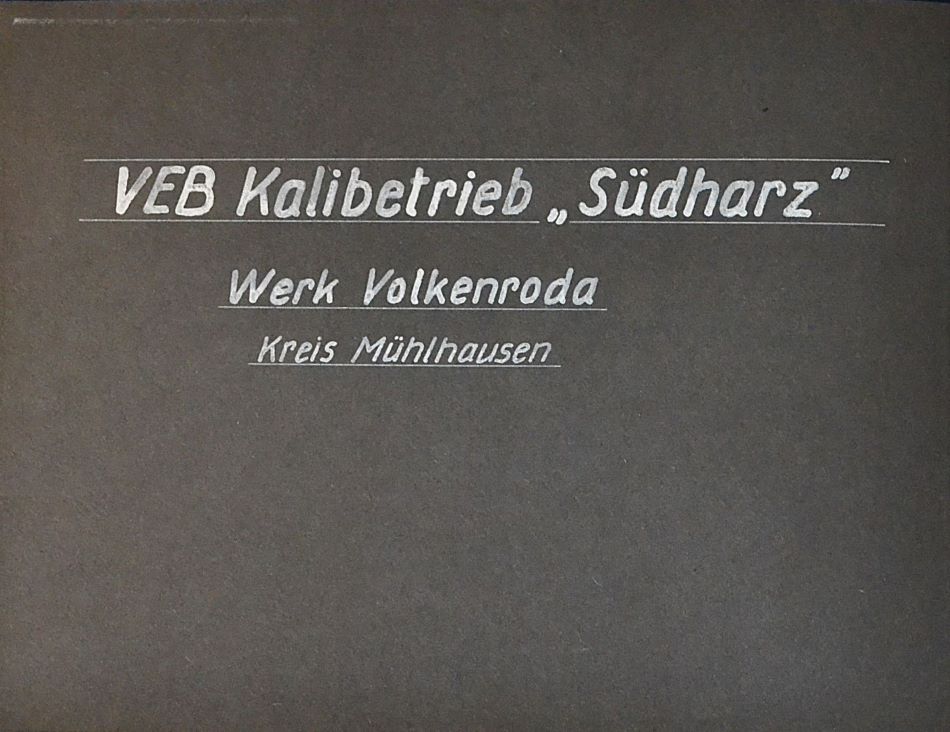
On the outside, it’s just a blue book with a cord binding and a few golden lines (see cover photo).
On the inside, it’s an entire world.
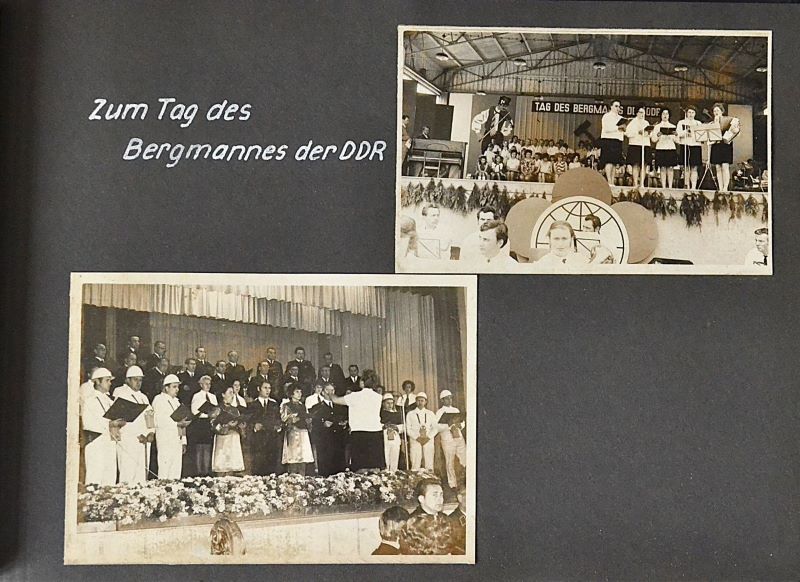
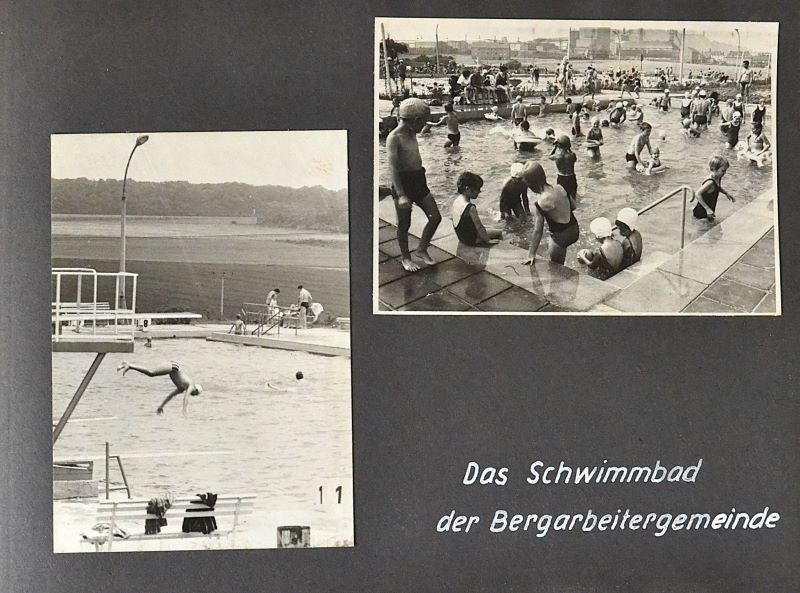
Buses line up in a depot. Huge machines disappear into an underground tunnel. Children splash in a swimming pool. A choir sings under banners celebrating “Miners’ Day of the GDR.”
What you’re holding is not a family album.
It’s the visual biography of a factory:
VEB Kalibetrieb “Südharz”, Werk Volkenroda, Kreis Mühlhausen
In plain English: the Südharz Potash Works at Volkenroda, a state‑owned mine and chemical plant in what used to be East Germany (the GDR).
This album was almost certainly produced by the company itself, probably in the 1960s–70s, as a kind of prestige object: part record, part propaganda, part love letter to the workers.
If you flip through it as you would any family album, it’s charming.
If you slow down and “read” it, it becomes something else: a crash course in how an entire socialist industrial community imagined itself.
Let’s walk through it, page by page, using it as a guide to history, technology, and everyday life.
2. Opening the Album: Where Are We, and What Are We Looking At?
The title page is written in neat white handwriting. That small detail already tells us something: this is not a mass‑printed book but a hand‑assembled album, probably prepared for visitors, party officials, or foreign delegations.
2.1. VEB – more than just three letters
VEB stands for Volkseigener Betrieb – “people‑owned enterprise.”
In the GDR, almost all large industries carried this label. It signaled that the factory did not belong to a private owner but to the socialist state, and, at least in theory, to the workers themselves.
Imagine every big factory in your city proudly calling itself “The People’s Plant.” The album’s very existence is part of that message.
2.2. Potash – the invisible mineral in your breakfast
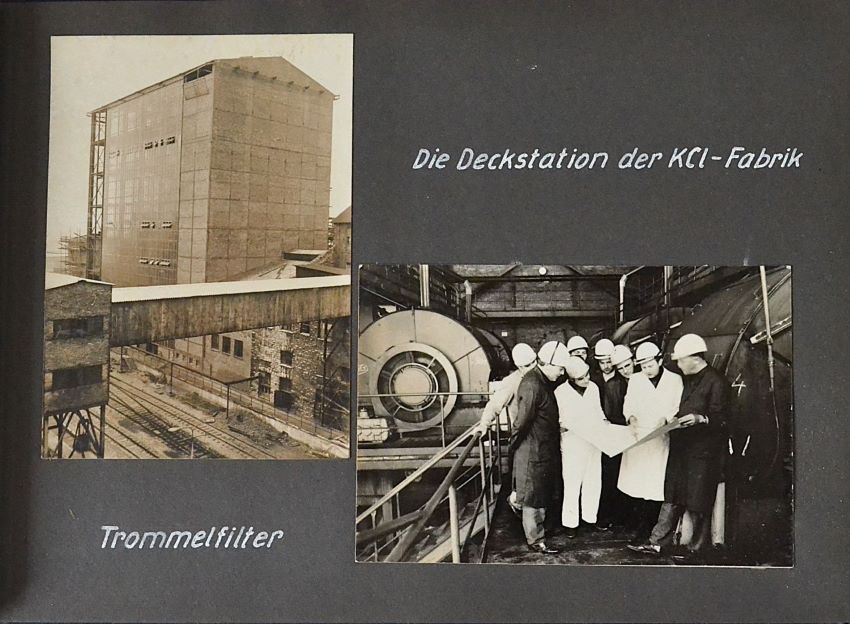
The Südharz works produced potash (KCl), a key ingredient in fertilizer. Without potash and other mineral fertilizers, the “Green Revolution” of the 20th century would have been impossible, and the world could not have fed itself billions of people.
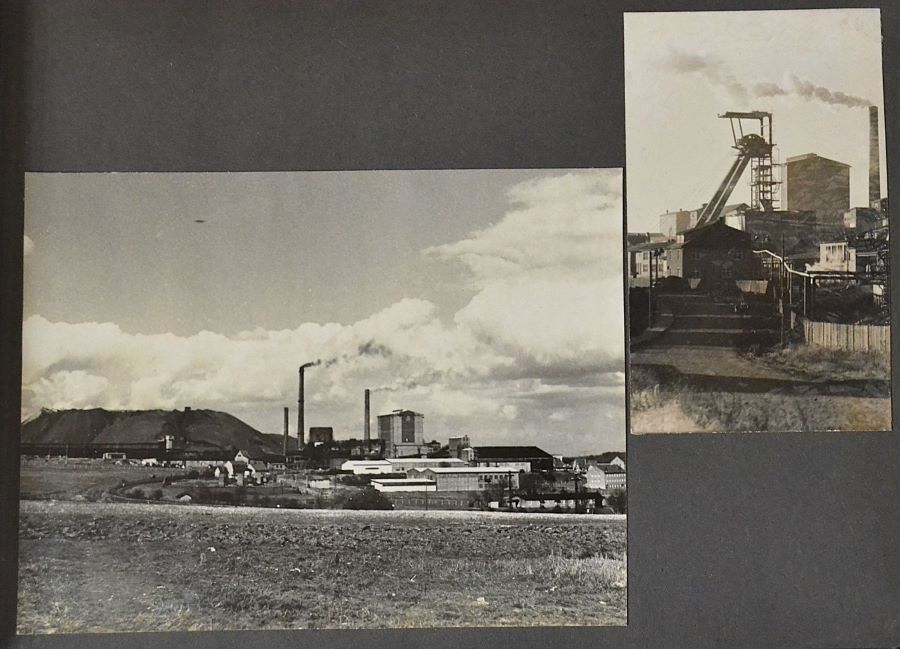
So when you see the early panoramic shots of the plant complex—the chimneys, the winding towers, the spoil heaps (third photo)—you’re not just looking at a local mine. You’re looking at an early link in the global food chain.
3. Underground Giants: How the Album Shows Work
After the buses and buildings, the album suddenly dives underground.
3.1. “Großgeräte – Untertage”: big toys in a dark playground
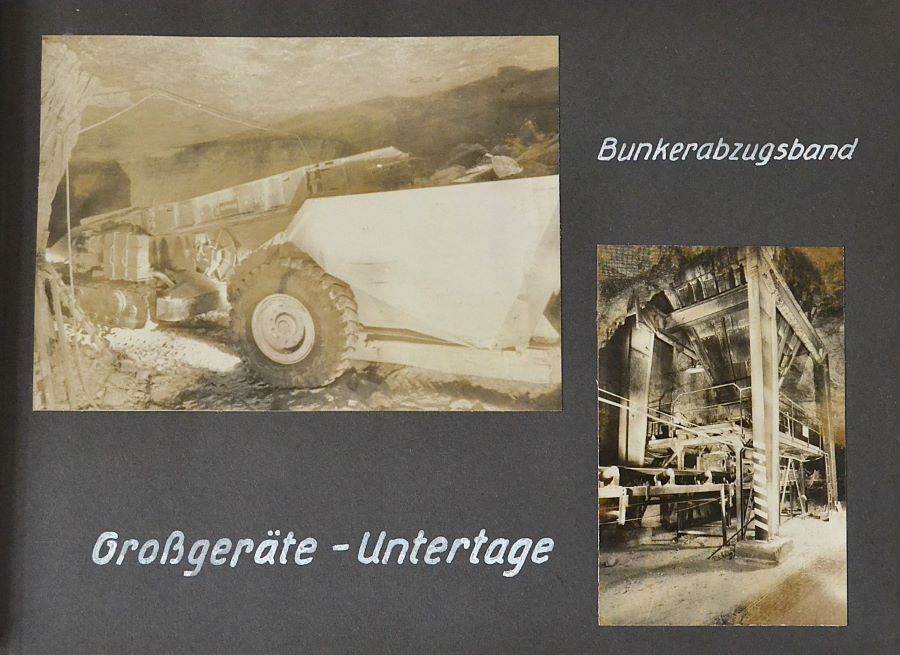
One spread shows massive vehicles under the rock ceiling, captioned “Großgeräte – Untertage” (large equipment underground) and “Bunkerabzugsband” (bunker discharge conveyor).
These images do three things at once:
Document technology – The GDR invested heavily in modern mining equipment; the vehicles you see are cousins of the machines still used today in salt and potash mines worldwide.
Stage heroism – The harsh light, the low tunnels, the vast rock surfaces: this is danger and modernity in one frame.
Make the invisible visible – Most people never see the places where the raw materials for their fertilizers, detergents, or road salt come from. The album opens those spaces for us.
Fun bit of general knowledge: in German cultural imagination, miners were traditionally considered an elite working group—disciplined, brave, and privileged. GDR propaganda loved them for that. You can already feel that aura here.
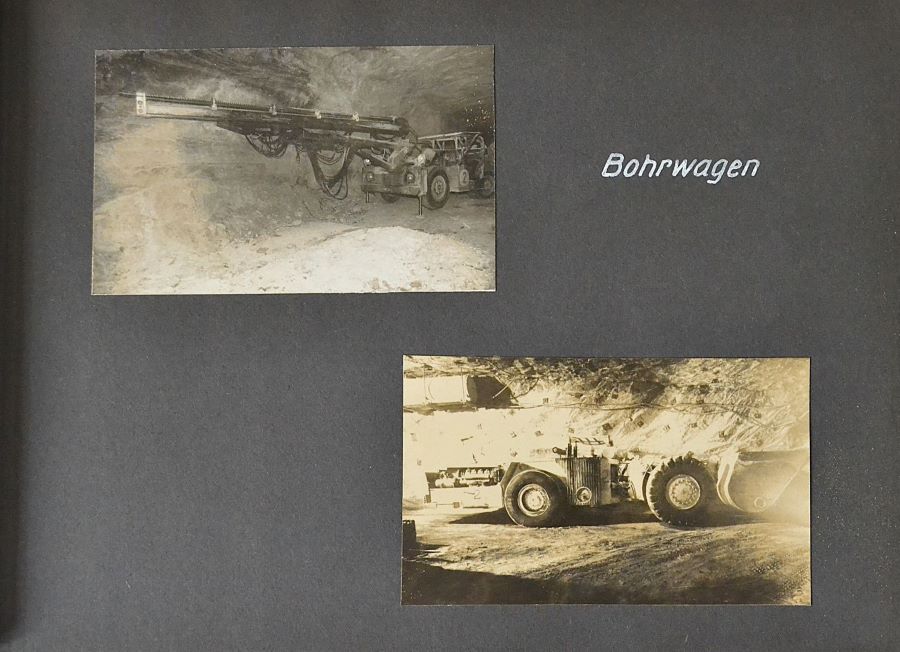
3.2. “Bohrwagen”: the drill that eats rock
Another pair of photos shows drilling rigs (“Bohrwagen”). These are the machines that drill holes for explosives or mechanized cutting.
The technical details may be lost on us today, but the visual language is clear:
The drill’s long arm stretches into the rock like a spear.
The vehicle’s cabin is tiny beside the tunnel height, enhancing the drama.
It’s industrial theater – and the miners are the protagonists, even when they’re not in the frame.
4. Above Ground: How a Socialist Factory Became a Small City
If the underground pages show how people worked, the rest of the album shows how they lived.
4.1. The Bus Station: commuting, but make it cinematic
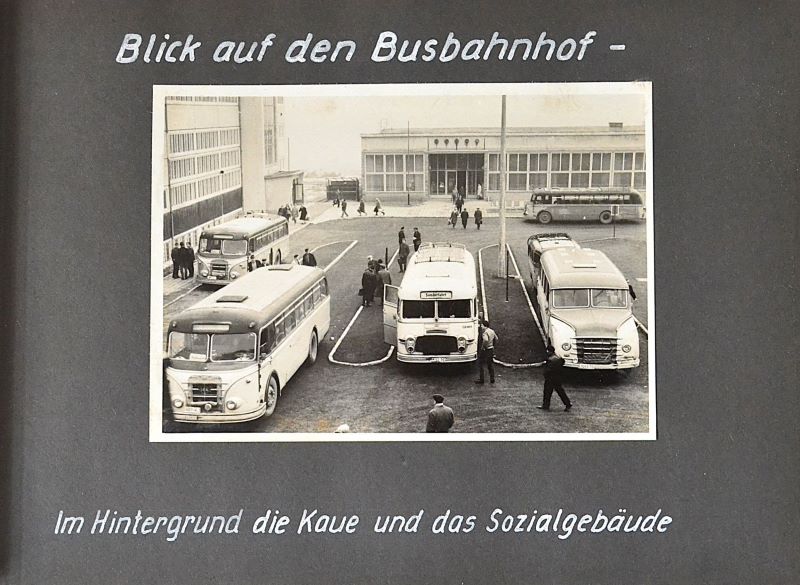
One early page is captioned:
“Blick auf den Busbahnhof – im Hintergrund die Kaue und das Sozialgebäude”
View of the bus station – in the background, the changing rooms and the social building.
Rows of buses are parked, and workers move across the asphalt.
In the GDR, private cars were rare and expensive. A large industrial plant, therefore, had its own bus fleet, running scheduled routes like a small public transport company.
The “Kaue” (changing building) in the background is another key element of mining culture. Miners would hang their clothes on chains that could be hoisted to the ceiling, both for drying and to prevent theft – a system still used in some mines today.
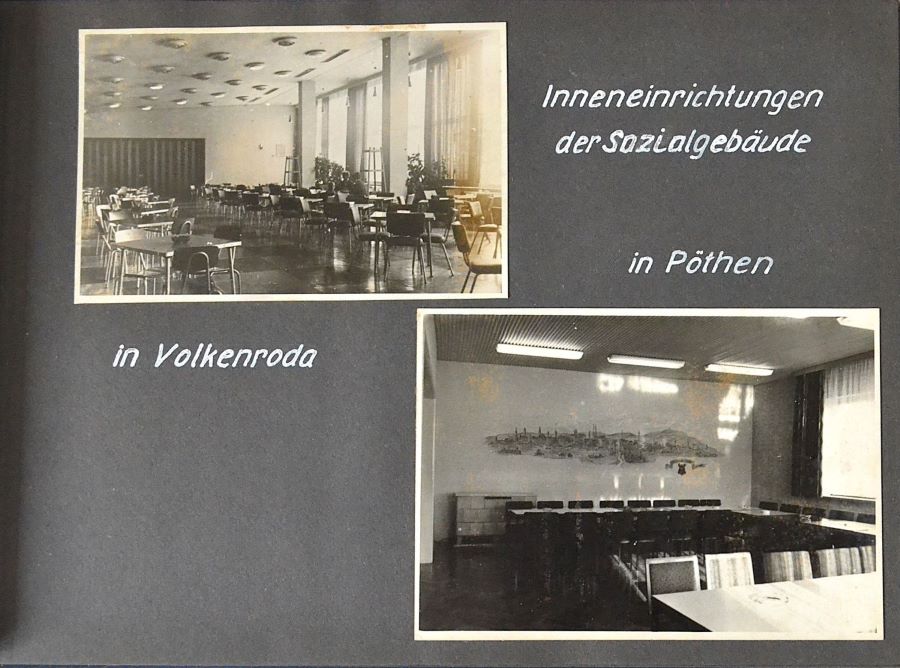
4.2. Social Buildings: canteens that look like ballrooms
Later spreads carry captions such as:
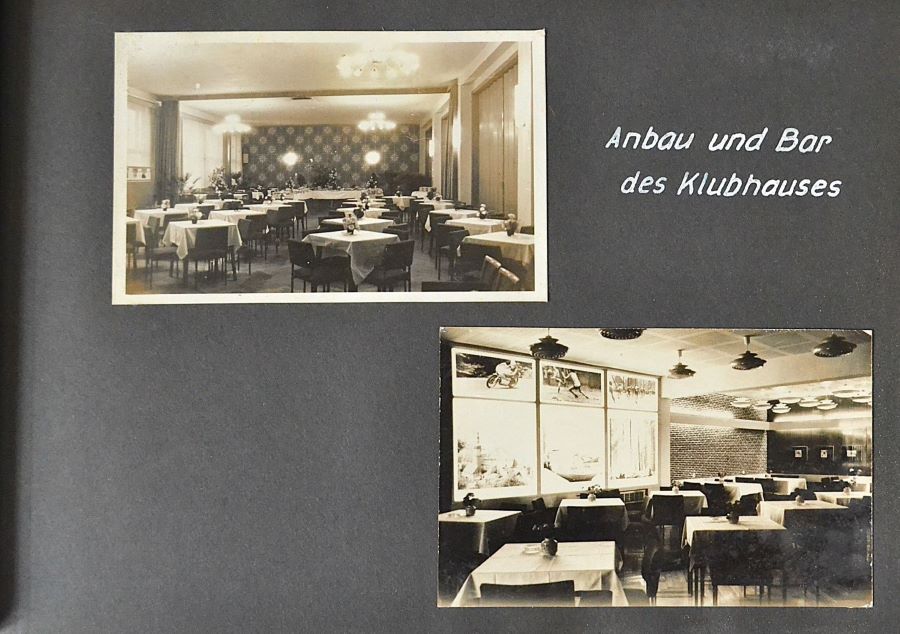
“Inneneinrichtungen der Sozialgebäude in Volkenroda / in Pöthen”
“Anbau und Bar des Klubhauses”
The photos show bright dining halls, neatly arranged tables, and even a stylish bar area with large windows.
This is more than interior design. It’s a visual argument:
We not only give workers a job; we provide them with culture, comfort, and a place to gather.
In the early industrial age in the West, companies like Krupp or Cadbury also built housing, parks, and social facilities to keep workers healthy and loyal. The GDR version is similar—but framed as a right granted by the socialist state rather than the generosity of a capitalist owner.
4.3. Clubhouse and culture: where free time became political
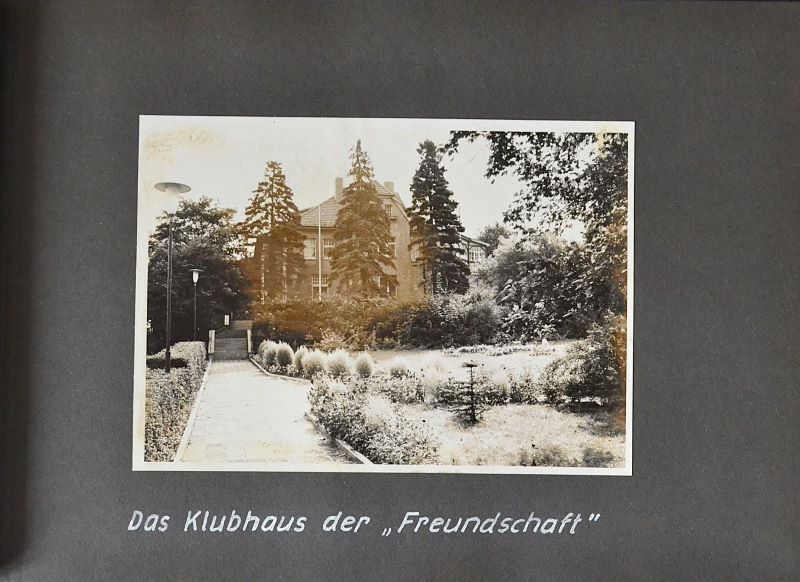
One beautiful photograph shows a lush garden leading up to “Das Klubhaus der ‘Freundschaft’” (the “Friendship” clubhouse). Inside pages reveal:
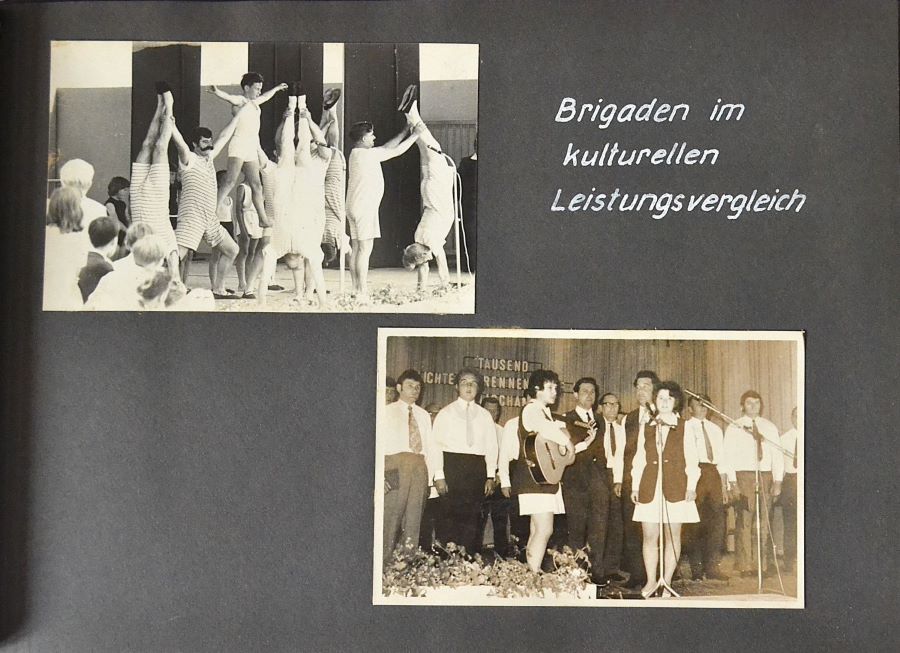
cultural competitions between work brigades,
gymnastic performances,
choirs and guitar ensembles on stage.
Cultural life in the GDR was heavily organized through workplaces. Join a choir, a theatre group, or a photography circle? You did it through your factory’s “Kulturhaus”.
So this album doesn’t just show a mine. It shows a complete ecosystem—work, leisure, and ideology intertwined.
5. Sport, Swimming Pools, and Summer Camps: The Body Politic
A series of pages reads almost like a tourism brochure:
The miners’ swimming pool – children and adults crowded in a public pool, with diving boards, a lake or reservoir in the background.
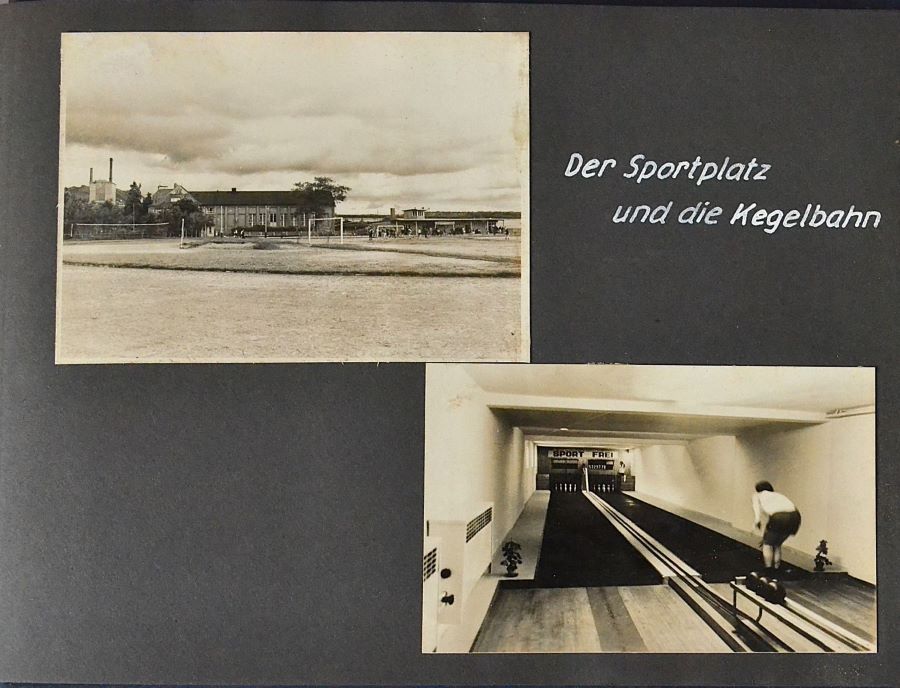
Sport field and bowling alley (“Kegelbahn”) – from outdoor football to indoor lanes.
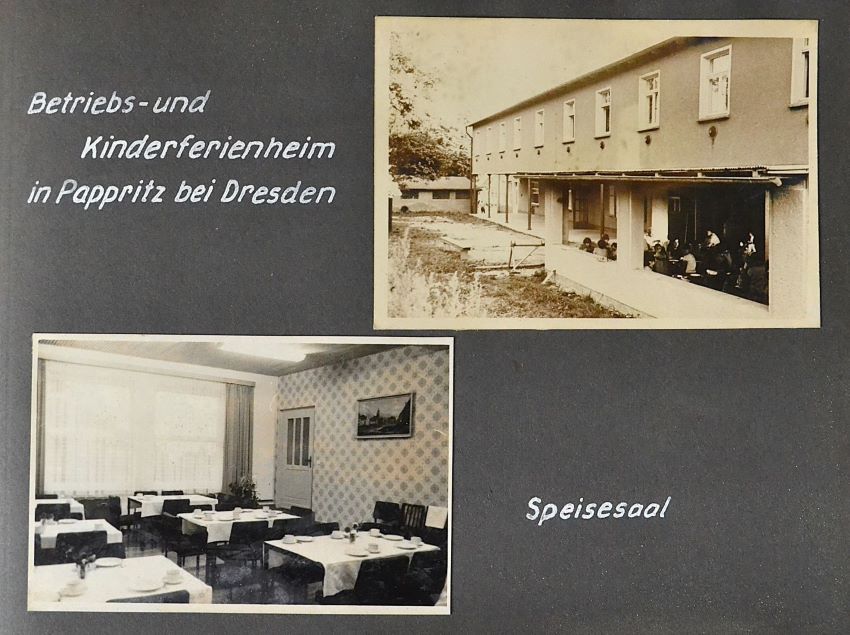
Holiday home near Dresden – captioned “Betriebs- und Kinderferienheim in Pappritz bei Dresden”, with a separate photo of the dining hall.
These images illustrate a core promise of socialist states:
If you work in heavy industry, you and your family will be taken care of from cradle to grave – including holidays, sports, and recreation.
In many Western welfare states, trade unions and large firms built similar facilities (think of Italian workers’ seaside colonies or French “comités d’entreprise” holiday centers). The key difference is who told the story.
In this album, the storyteller is the factory itself, presenting a curated, optimistic view of life under its roof.
6. Doctors, Dentists, and Rescue Teams: Safety as a Collective Duty
The album is unusually detailed in showing health and safety.
6.1. From underground accidents to the company clinic
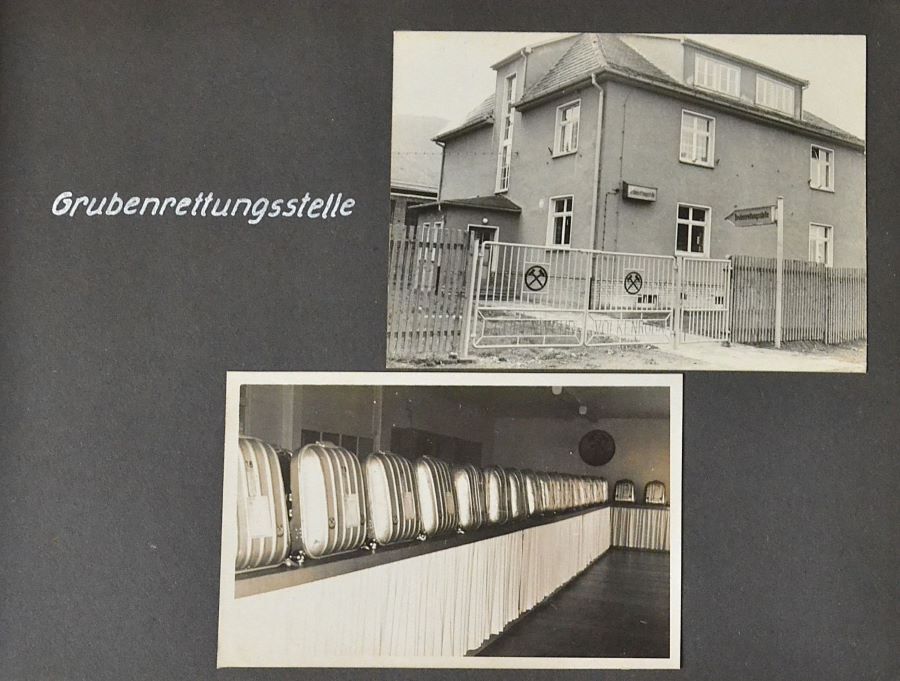
One page is titled “Grubenrettungsstelle” – the mine rescue station.
The upper photo shows the building and gate, marked with crossed hammers, the traditional miners’ symbol.
The lower one displays rows of rescue breathing apparatuses lined up like helmets in an armory.
Further pages show:
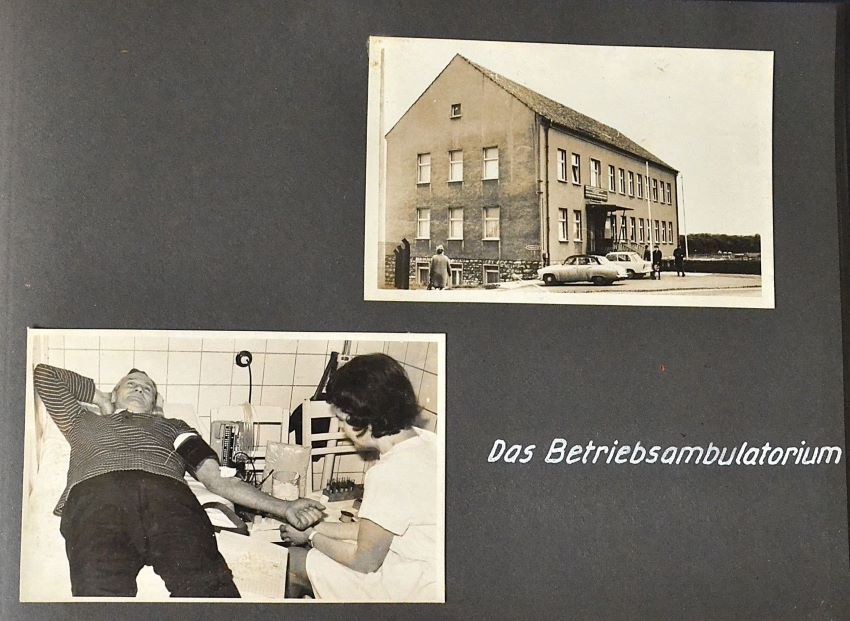
“Das Betriebsambulatorium” – the company outpatient clinic, outside and inside.
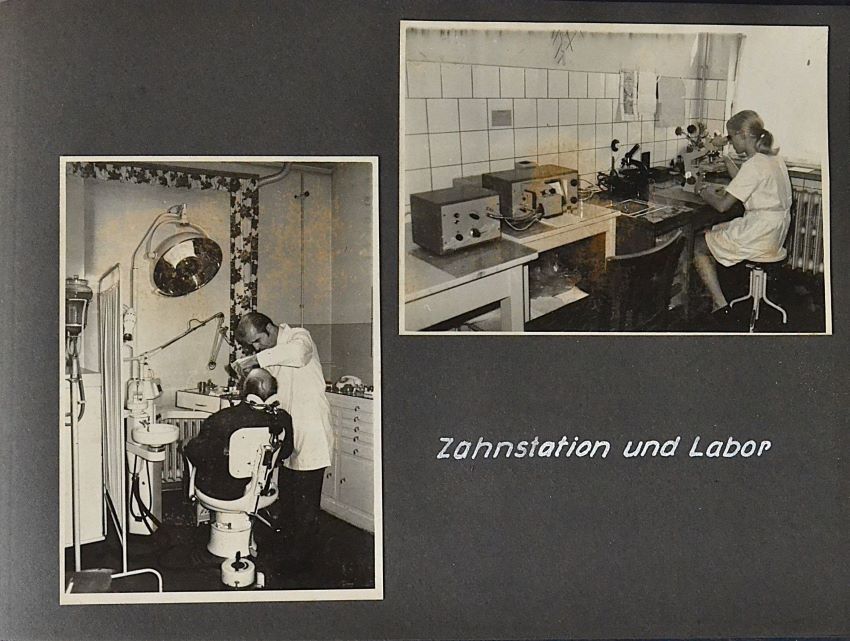
“Zahnstation und Labor” – dental practice and laboratory, with a dentist at work and a technician making dental prostheses.
Industrial work is dangerous; mining is even more so. In the late 19th century, many European countries introduced special miners’ insurance schemes. The GDR expanded this into a highly visible network of company‑based medical care.
The album almost reads like a checklist:
Rescue service? ✔
Clinic? ✔
Dentist? ✔
Every photo quietly repeats the same message: Here, the worker is protected.
6.2. The Workers’ Militia: helmets for a different kind of danger
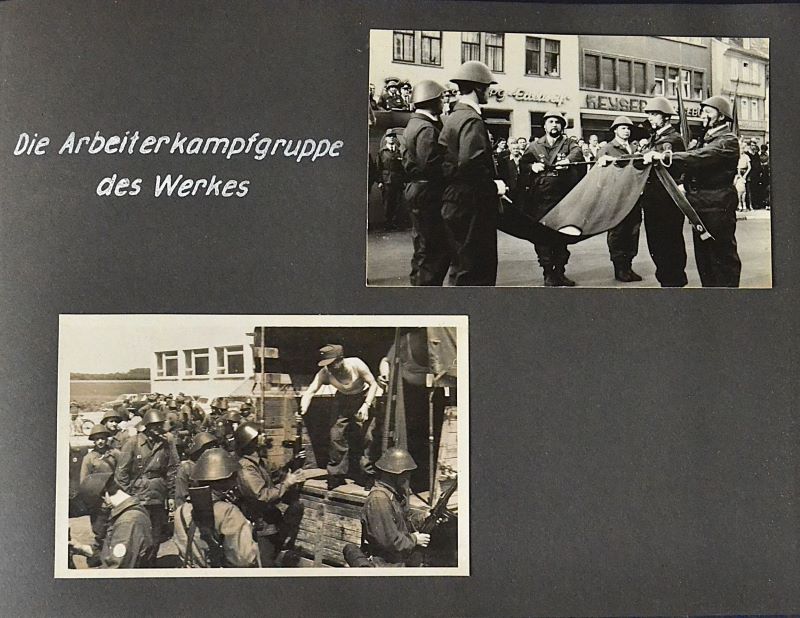
Then the mood shifts. A spread titled “Die Arbeiterkampfgruppe des Werkes” (the factory’s workers’ combat group) shows uniformed workers in training and on parade.
In the Cold War, factories in the GDR had their own Arbeiterkampfgruppen, paramilitary units meant to defend key installations and, if necessary, the socialist order.
From today’s perspective, these images are mildly surreal: the same workforce that appears in choir robes and swimwear also appears in helmets and field uniforms. But in the logic of the time, it was consistent: industrial workers were framed as the front line of both economic production and ideological struggle.
7. Minds at Work: School, Lab, and Library
The album doesn’t stop at bodies and machines; it also shows how minds were shaped.
7.1. Vocational school and lab
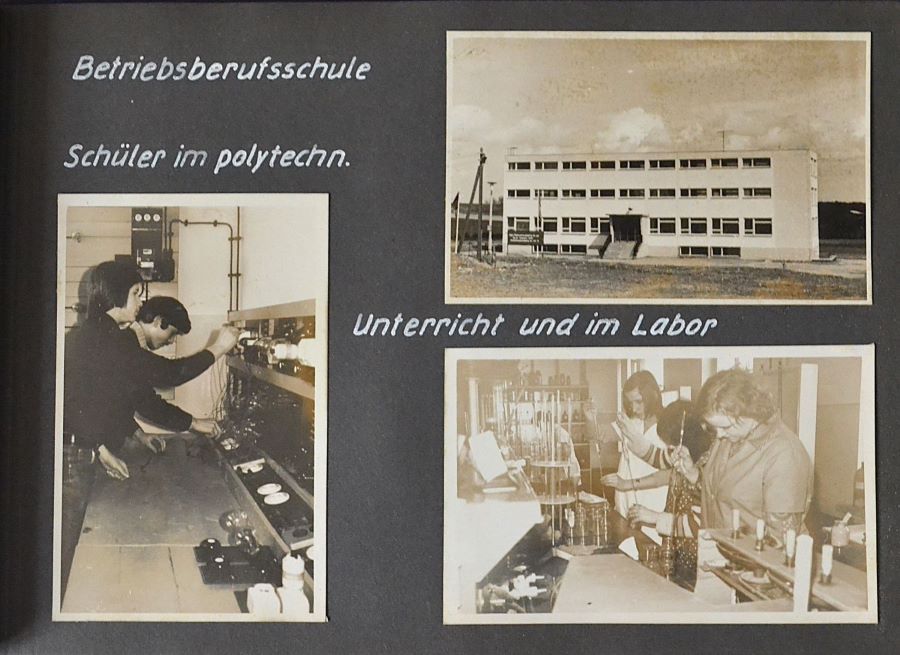
The “Betriebsberufsschule” (company vocational school) gets its own page:
One photo shows the school building.
Another, “Schüler im polytechn. Unterricht und im Labor”, features young people working with electronics and glassware.
The term polytechnical education was a key concept in Eastern Bloc pedagogy: students were expected to link theoretical knowledge with practical skills, often directly related to local industry.
7.2. The union library – 6,000 volumes of carefully curated knowledge
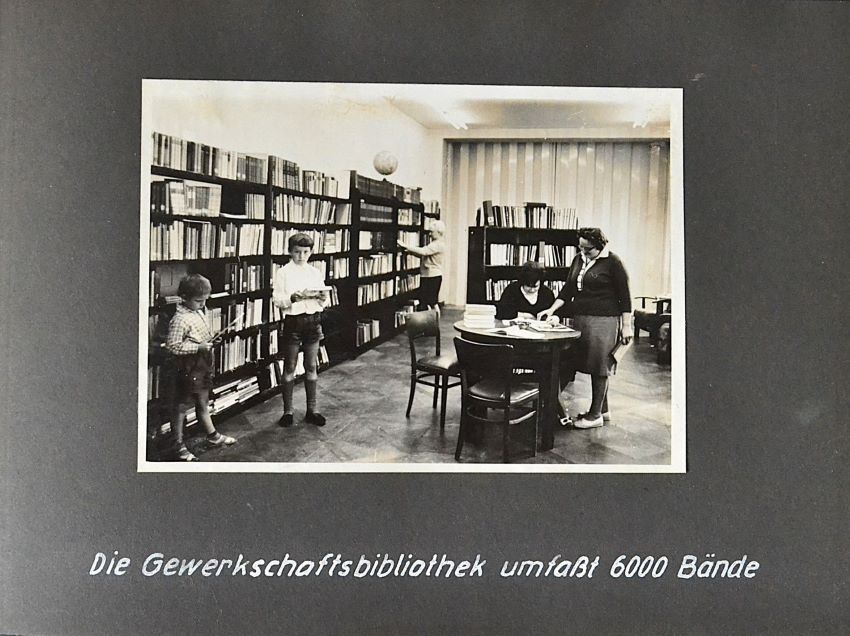
One of the most evocative photos shows a quiet room lined with bookcases, children and adults browsing shelves, the caption:
“Die Gewerkschaftsbibliothek umfaßt 6000 Bände”
The trade union library comprises 6,000 volumes.
Libraries in factories may sound exotic today, but they were once common in both East and West. They functioned as:
leisure spaces,
continuing‑education resources,
and subtle vehicles for ideology (book choices were not random).
Here, again, the album is making an argument: this is not just a mine – it’s a cultural institution.
8. Festivals, Choirs, and Miners’ Day: When Work Became Ceremony
Several pages show large groups on stage: choirs, ensembles, and award ceremonies. Captions mention:
“Brigaden im kulturellen Leistungsvergleich” – brigades in cultural performance competition.
“Zum Tag des Bergmannes der DDR” – for the GDR miners’ day.
“Workers’ brigades” were small teams within a factory, often competing for productivity prizes and honorific titles. Here, they compete artistically, not just economically.
Miners’ Day, celebrated annually, blended:
traditional miners’ customs (music, parades, festive clothing),
with socialist symbolism (banners, party officials, awards).
The album freezes these staged moments, giving us a rare composite: a modern industrial workforce wrapped in the ceremonial robes of both old guild traditions and new political rituals.
9. The Last Industrial Glimpse: “Teilansicht der Schachtanlage Pöthen”
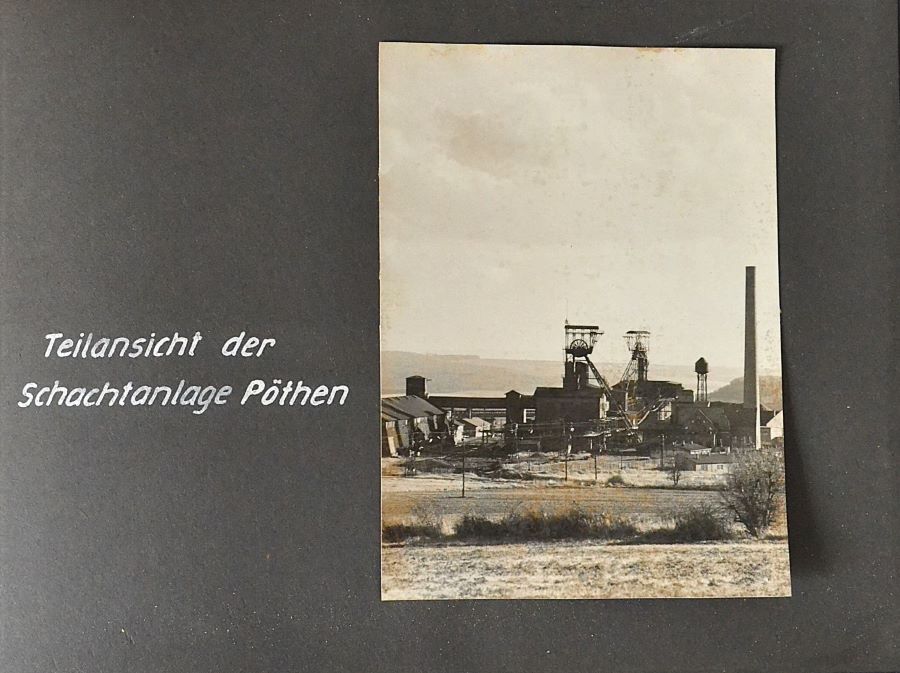
Near the end, a single vertical photograph shows another shaft complex, captioned “Partial view of the Pöthen shaft installation” (second‑to‑last photo).
By this point, you recognize the visual vocabulary: chimneys, headframes, flat surrounding fields. Yet after pages filled with clubs, pools, and libraries, this lonely industrial landscape looks almost melancholic.
It’s a quiet reminder: everything in the album ultimately exists because of this—the extraction of mineral wealth from underground.
The final blue back cover closes the circle (last image): a solid, anonymous surface hiding a densely layered world.
10. How to “Read” a Historical Photo Album Like This (In 5 Quick Moves)
To make the most of an album like this—whether you’re a historian, collector, or just curious—try this mini‑method:
Read the captions carefully
They’re often ideological; the photos sometimes contradict or nuance them. Note what is named and what is left vague.
Map the places
Look up Volkenroda, Pöthen, Pappritz on a map. Geography turns isolated images into a network.
Track recurring themes
Work, leisure, safety, ideology, family—how many pages are devoted to each? That tells you what the creators thought was important.
Compare with other contexts
Think of similar photo stories from Western company magazines, or from today’s corporate websites. What has changed? What hasn’t?
Remember the invisible
Every curated album leaves things out: night shifts, conflicts, pollution, boredom. The gaps are as revealing as the images.
11. Why Albums Like This Matter Today
At first glance, this blue album is a relic from a vanished state. But it speaks to issues that are still with us:
Who owns industry? – and who gets to tell its story?
How are workers represented in official imagery—then and now?
What does a “good life” around a factory look like?
Corporate social media accounts today still highlight wellness programs, training, diversity initiatives, and cool technology—just as this album highlighted canteens, clinics, cultural clubs, and drilling rigs. The tools have changed; the narrative strategies are surprisingly familiar.
So the next time you come across a forgotten company photo album at a flea market or in a family attic, treat it like what it really is:
a slow, silent movie about how people once imagined the future—and about the world of work that quietly built the one we live in now.
Find related collectibles that complement your current collection. From pieces of the same era or by the same artist to similar themes or materials, these related products are sure to add value and interest to your collection. Discover new gems and expand your collection with our carefully curated selection.
Take your collecting passion to the next level by diving into the history and cultural significance of your favorite pieces. Our expertly curated articles provide in-depth information on rarity, value, and more. Discover hidden gems and gain a deeper appreciation for the collectibles you love with our latest articles.
“James Bond Greatest Hits: Iconic Sounds of Jazz, Rock, Pop, Stage and Screen” Summary: Welcome to the irresistible

Summary The lush soundscapes of “Discovery” are like a time machine that sucks you right back into the
Summary Welcome to the sonic rollercoaster that is “Hysteria,” the 1987 masterpiece by Def Leppard. This vinyl record,
Free shipping in the UK for orders over £50, and in Europe/North America for orders over £100.
At CelebrisClub, we believe that every collectible tells a story. That’s why we provide you with the most detailed and informative information on ultra-rare collectibles. From limited-edition releases to vintage finds, our expertly curated selection offers a wide range of collectibles for every collector. Expect high-quality images, in-depth articles, and a trustworthy and enjoyable shopping experience. Join us on a journey to discover the hidden gems of collecting and unlock the world of ultra-rare collectibles.
© 2023 CELEBRISCLUB – All rights reserved.
Reviews
There are no reviews yet.
Only logged in customers who have purchased this product may leave a review.