Summary
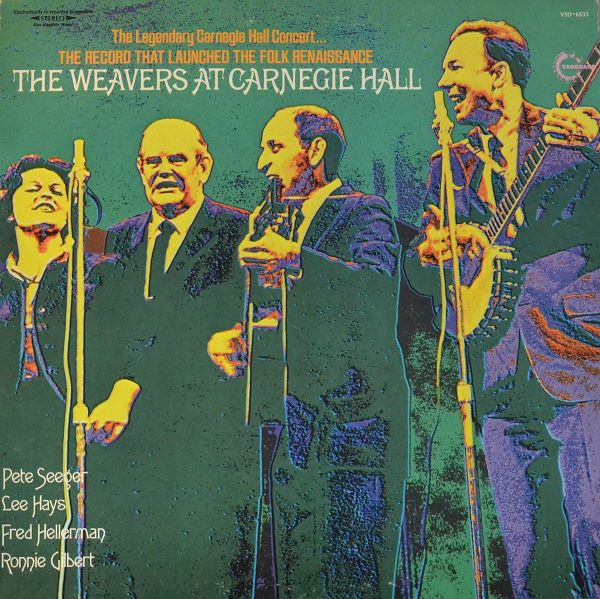
“At Carnegie Hall” is the Weavers’ victory-lap live album—pressed here in a 1970 Vanguard reissue (catalog VSD 6533) that keeps the electricity of their famed mid-’50s comeback concert alive. It’s folk music with a stagecraft grin: harmony-rich, audience-powered, and historically important. You get protest roots wrapped in singalong choruses, world folk threaded with American traditionals, and between-song banter that feels like a friend nudging you to join in.
Quick facts:
Artist: The Weavers (Pete Seeger, Lee Hays, Ronnie Gilbert, Fred Hellerman)
Title: At Carnegie Hall
Label/Catalog: Vanguard VSD 6533 (1970 press of the classic concert)
Genre: Folk revival, traditional, protest folk
Format: Live recording, Carnegie Hall, NYC
Vibe: Joyful, communal, quietly radical/
About the Artist
Before this album, the Weavers had already helped define American folk for the masses. Formed in 1948 at New York’s Village Vanguard, the quartet fused:
Traditional ballads and work songs (from Appalachia to the Sea Islands)
Black and Jewish diasporic traditions
Global folk (Hebrew, African, Cuban, and more)
Topical material delivered with humor and heart
They scored huge early-’50s hits—“Goodnight, Irene,” “On Top of Old Smoky,” “Tzena, Tzena, Tzena,” “Wimoweh”—but were derailed by blacklisting in the McCarthy era. Radio bans, record contracts canceled, tours stopped. The group fractured, then regrouped. Pete Seeger doubled down on banjo-powered activism, Lee Hays wrote with sly wit, Ronnie Gilbert’s booming contralto became a north star, and Fred Hellerman anchored harmonies and arrangements.
By the mid-’50s, their return to the stage at Carnegie Hall was more than a concert. It was a statement. Folk music could be joyous, subversive, and big-room worthy. That moment helped re-light the fuse for the folk revival that would soon carry The Kingston Trio, Odetta, Joan Baez, Bob Dylan, and Peter, Paul, and Mary.
About the Record
At its core, “At Carnegie Hall” is a live folk masterclass:
Themes: Dignity of labor, love and loss, migration and exile, peace, shared heritage
Style: Four-part harmonies, banjo sparkle, nimble guitars, bass thump, call-and-response
Tone: Inclusive and celebratory—serious songs sung with a smile
Significance:
A landmark of live folk recording. It shows how traditional songs can fill a prestige hall without losing campfire intimacy.
A comeback document. In the wake of blacklisting, this was both musical proof-of-life and cultural restoration.
A blueprint for audience participation. The singalong model you hear on later folk and gospel-influenced live albums owes plenty to this set.
How it differs from earlier studio Weavers:
Rawer and warmer. Less polished than their 1950–51 hits, but more direct.
More global in one sitting. You feel the stylistic hopscotch—from American traditionals to Hebrew and African-rooted material—in real time.
Banter and context baked in. The talking matters as much as the singing; you’re part of the room.
About the Cover
Vanguard sleeves from this era leaned on bold, readable typography and straightforward photography or illustration—classy, unfussy, very “serious record collector” energy. “At Carnegie Hall” fits the bill: a dignified, no-gimmick presentation that lets the venue name do the heavy lifting. The design telegraphs exactly what’s inside—heritage repertoire, famous stage, history being made—without screaming. Liner notes (on most pressings) frame the blacklist backstory and the group’s repertoire choices, turning the jacket into a mini field guide to folk revival values.
About the Lyrics & Music
This is where the album shines. The Weavers take familiar melodies and reveal layers—musical roots, migration paths, politics in plain sight.
Standout moments and themes:
Kisses Sweeter Than Wine: A dreamy, gently swinging love song whose lineage threads through Irish melody and the work of Lead Belly. Proof that folk history is a braid, not a straight line.
Wimoweh: Their choral arrangement of Solomon Linda’s “Mbube” is spine-tingling in a hall. It’s also a case study in how global songs traveled and were adapted in mid-century America.
Goodnight, Irene: Lead Belly’s classic as big-room lullaby. The Weavers’ early-’50s hit version made this song ubiquitous; live, it becomes a farewell hymn that everyone knows.
Pay Me My Money Down and Work-song staples: Unionist backbone with a party face—rhythms built for clapping and stomping, lyrics that carry worker dignity.
Musically, expect:
Four-way blend: Gilbert’s strong lead; Seeger’s banjo and bright tenor; Hellerman’s guitar glue; Hays’ warm, grounding voice.
Minimalist miking with maximum room bloom: Carnegie Hall’s natural reverb wraps the harmonies. The recording keeps things simple—stage mics, tube-era warmth, little to no studio sweetening—so you hear the hall, the breath, the crowd.
Built-in dynamics: Songs shift from single-voice intimacy to full-quartet lift, then spill into audience sing-alongs. It’s choreography by harmony.
Reception and impact:
Critics and collectors have long treated this as a cornerstone live folk document. It routinely surfaces in Record Collector-style rundowns of must-own folk LPs and gets nods from reissue specialists for its historical weight.
Industry ripple: It validated folk as concert-hall music and influenced how labels like Vanguard curated the revival.
Legacy: You can hear its DNA in Pete Seeger’s own We Shall Overcome (Carnegie Hall, 1963), in Peter, Paul, and Mary’s live arrangements, and in the communal ethos of countless coffeehouse-to-concert transitions.
Conclusion
If you want a record that explains—joyfully—why folk music mattered then and still matters now, “At Carnegie Hall” is it. The Weavers turn a prestigious room into a living room, smuggle courage into catchy choruses, and make history sound like a party you’re invited to. This 1970 Vanguard pressing preserves the glow and the grit. File under: evergreen, in every sense.
Other Recommendations
The Weavers – Reunion at Carnegie Hall, 1963 (Vanguard): Older, wiser, still luminous. A perfect companion to this set.
Pete Seeger – We Shall Overcome: The Complete Carnegie Hall Concert (Columbia): Solo Seeger, maximum singalong, a masterclass in crowd-leading.
Odetta – At Carnegie Hall (RCA): Majestic voice, authoritative repertoire; another essential live folk document.
Joan Baez – In Concert (Vanguard): Pristine soprano, nimble guitar, and a bridge to the ’60s protest wave.
The Kingston Trio – At Large (Capitol): Pop-folk polish with tight harmonies; you’ll hear the Weavers’ blueprint at work.
Peter, Paul and Mary – In Concert (Warner Bros.): Polished, heartfelt, and deeply influenced by the Weavers’ communal style.
Notes for crate-diggers:
Vanguard pressings are generally well-cut, with honest, room-forward sound. Clean copies of VSD 6533 can be quite detailed.
Tracklists vary slightly across reissues; many center on the Weavers’ core repertoire listed above.
For discographic specifics and matrix details, cross-check the Discogs entry for The Weavers’ At Carnegie Hall and Vanguard catalogs.