Summary
“Night Owl” is Gerry Rafferty’s late‑night confession set to wax.
Released in 1979 on United Artists (catalogue UAK 30238), this is the follow‑up to his monster hit album “City to City.” Where “Baker Street” made him a global name, “Night Owl” shows what fame felt like from the inside—the hangovers, the self‑doubt, the flashes of joy, and the stubborn hope.
Musically, it’s smooth soft‑rock and folk‑rock with that unmistakable Rafferty blend: warm acoustic guitars, silky sax lines, and melodies that sound like they’ve always existed. On vinyl, the record really breathes; the arrangements feel wide and three‑dimensional, and the late‑70s analogue sheen is all over it.
If “City to City” is the big city skyline at sunset, “Night Owl” is the walk home at 2 a.m. when the streets are empty and your thoughts are loud.
About the Artist
Before he was a staple of soft‑rock radio, Gerry Rafferty was a working‑class kid from Paisley, Scotland, soaking up skiffle, folk, and rock ’n’ roll.
In the late 1960s, he played with The Humblebums, alongside a then‑unknown Billy Connolly.
In the early 1970s, he co‑founded Stealers Wheel, scoring the enduring hit “Stuck in the Middle With You.”
He launched his solo career with “Can I Have My Money Back?” (1971), but his real breakthrough came later.
Everything changed with “City to City” (1978) and its iconic single “Baker Street”, complete with Raphael Ravenscroft’s soaring sax line. The album went to the top of the charts in several countries, and suddenly Rafferty—never a huge fan of the music industry—was a reluctant star.
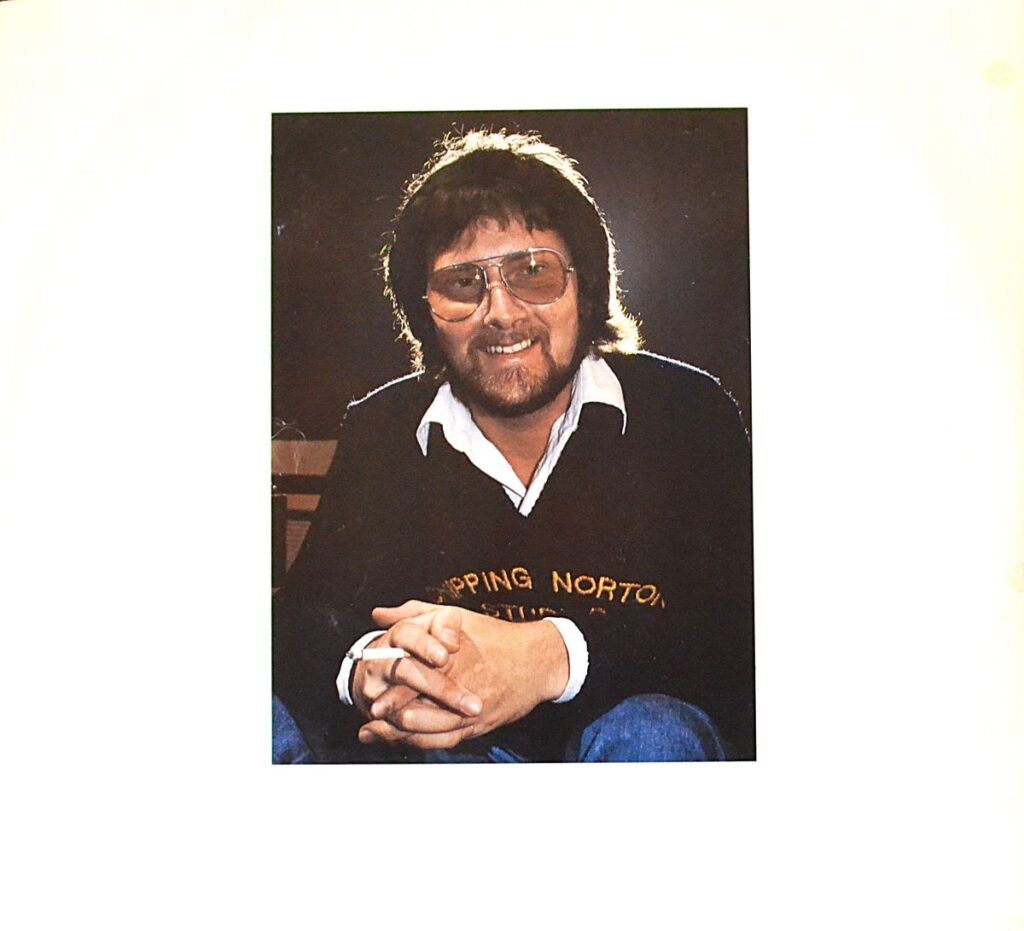
By the time he started work on “Night Owl”, he was:
Financially successful but wary of the business. Wrestling with the pressure of following up on a global hit. Deep in a creative purple patch—writing some of his most personal songs.
You can hear all of that on “Night Owl.” It’s the sound of a songwriter who has “made it” and is quietly asking, “Was it worth the cost?”
About the Record
“Night Owl” keeps the polished, radio‑friendly sound of “City to City” but points the camera inward.
Genre‑wise, file it under:
Soft rock / AOR. Folk‑rock. A touch of Celtic‑coloured singer‑songwriter introspection
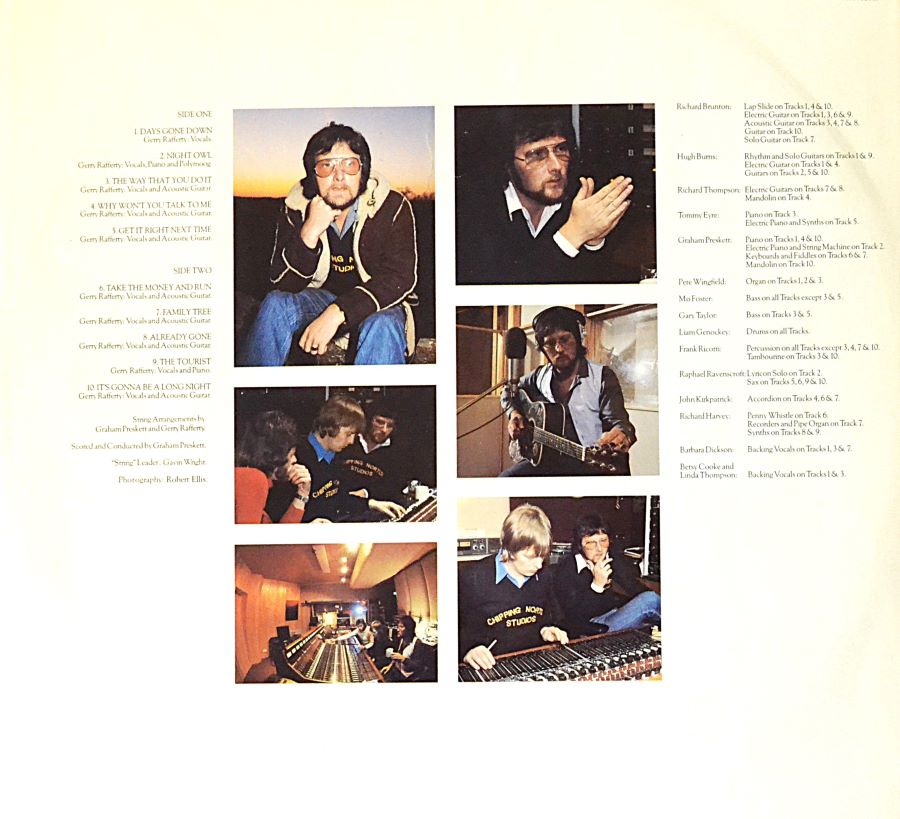
The record was produced by Gerry Rafferty and Hugh Murphy, the same team behind “City to City,” and features a similar palette:
Rich acoustic and electric guitars, warm keys and organ, tasteful saxophone (yes, Raphael Ravenscroft is back). Layered backing vocals and meticulous arrangements.
Themes & mood
Where “City to City” often looked outward—travel, escape, the big city—“Night Owl” is introspective, nocturnal, and a bit haunted. Common threads in the lyrics:
The dark side of success – burnout, isolation, and mistrust of the industry. Alcohol and self‑medication – late nights, long bars, short answers. Holding onto inner light – hints of spiritual searching and stubborn optimism. You feel it in song titles alone: “Night Owl,” “Get It Right Next Time,” “Take the Money and Run,” “It’s Gonna Be a Long Night.”
Place in Rafferty’s discography
“Night Owl” arrived fast—just a year after “City to City.” It:
Confirmed, Rafferty was no one‑hit wonder; he could write albums, not just singles.
Hit the UK album charts and spawned several successful singles, notably
“Days Gone Down (Still Got the Light in Your Eyes)”, “Get It Right Next Time”, “Night Owl”.
It was praised for craftsmanship, even if it didn’t replicate the blockbuster numbers of its predecessor.
Contemporary reviews in the UK music press often noted:
The darker, more personal tone compared to “City to City.” The top‑tier songwriting and production, even when they wished for another “Baker Street”‑sized smash. Over time, many fans and collectors have quietly upgraded “Night Owl” from “follow‑up” to “favourite.” It’s frequently cited as his most emotionally cohesive album.
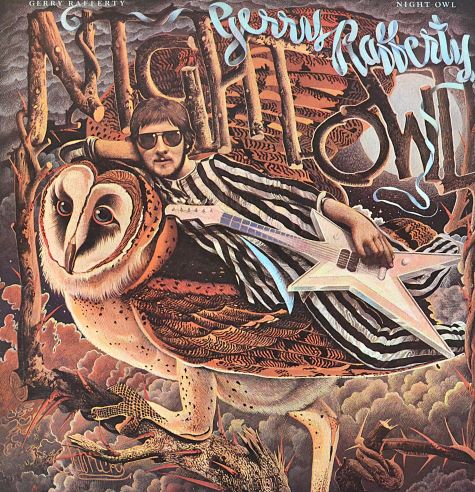
About the Cover
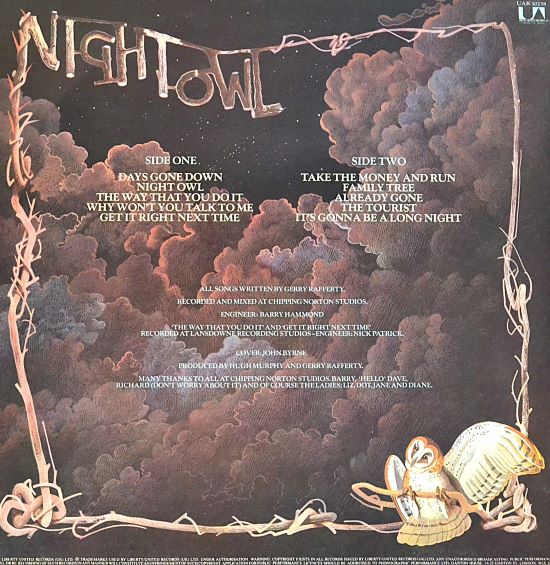
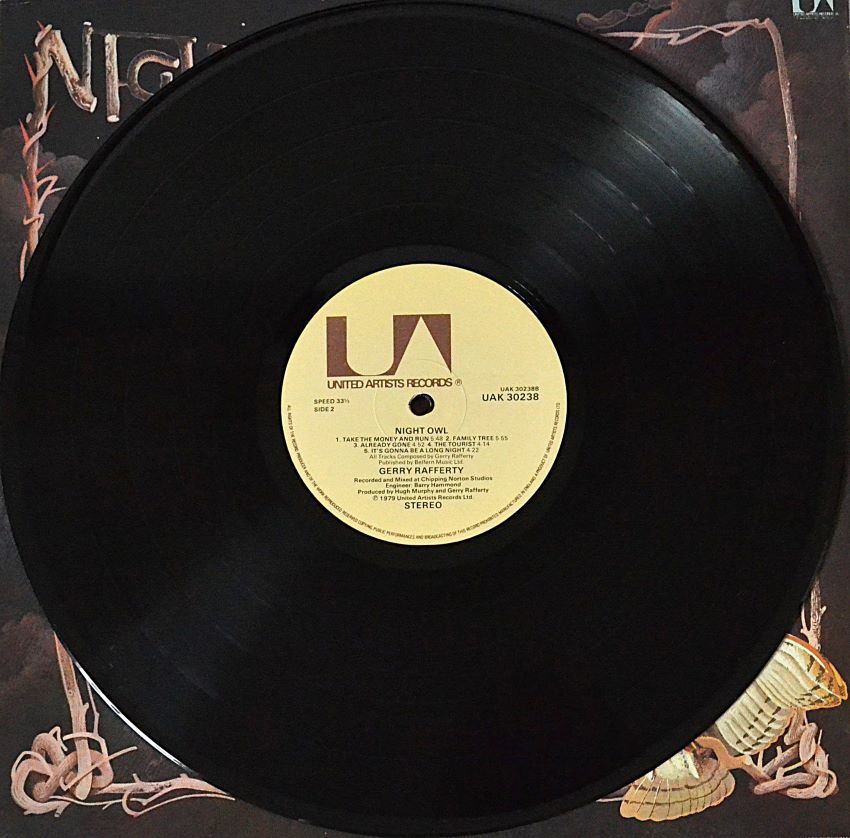
Pull the record from its sleeve, and you’re greeted by a distinctly late‑70s piece of surreal, nocturnal art. Without getting lost in tiny visual details, the cover:
Leans into owl and night imagery, as the title promises. Uses cool, twilight colours—blues, purples, and dark tones that instantly suggest late hours. Blends urban and dreamlike elements, mirroring the album’s tension between fame’s bright lights and internal shadows. It’s not the straightforward “photo of guy with guitar” sleeve you might expect from a singer‑songwriter in 1979. Instead, it feels like:
A visual echo of the songs: slightly mysterious, a bit melancholic, and unmistakably nighttime. On a turntable or in a record bin, the cover does what good album art should do: it sets the mood before the needle even drops.
About the Lyrics & Music
“Night Owl” is one of those records where the sequencing really matters. Side A pulls you into the world; Side B deepens it and lingers after it’s over.
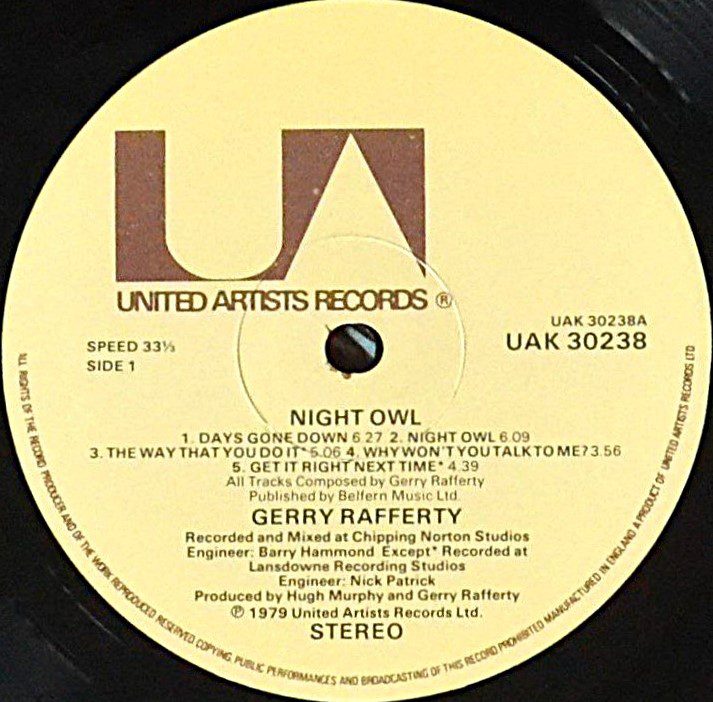
Let’s look at the music and a few standout tracks. “Days Gone Down (Still Got the Light in Your Eyes)” – Side A, Track 1
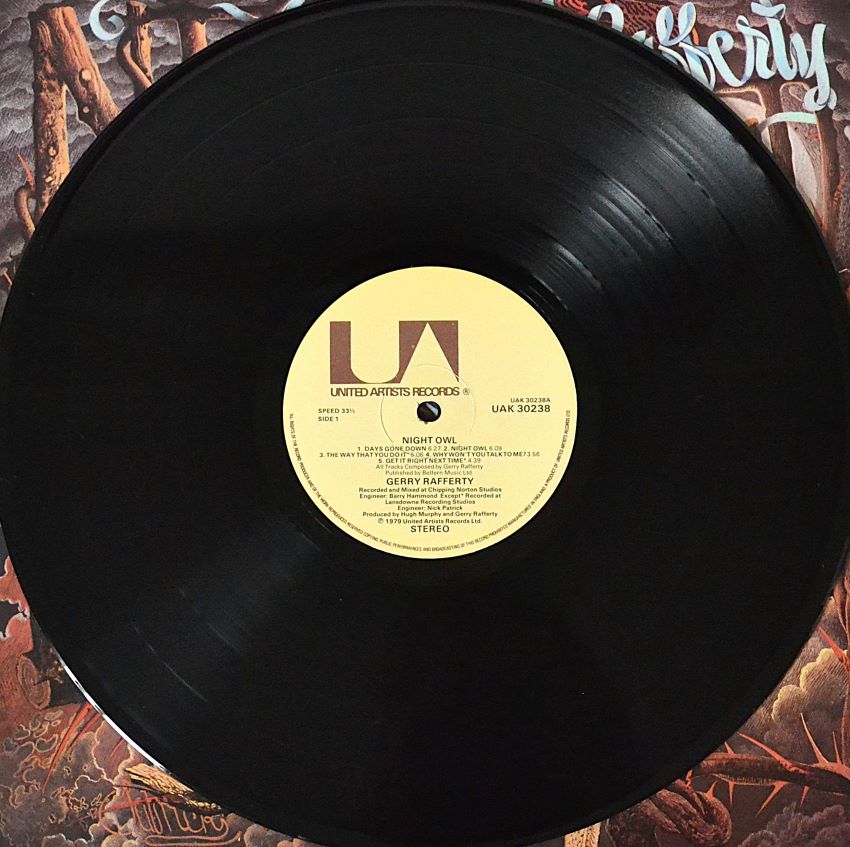
A perfect opener. Bright, melodic, and deceptively upbeat.
Musically:
Mid‑tempo soft rock with a breezy groove. Acoustic guitars and keys locked together. A hooky chorus that sticks immediately.
Lyrically:
Nostalgia mixed with resilience. A sense of someone who’s been through the wringer but “still got the light”—an idea that recurs across the record. It reassures you: yes, this is still the Gerry Rafferty you loved on “City to City,” but listen closely, and you’ll hear more scars.
“Night Owl” – Side A, Track 2
The title track is the emotional blueprint of the whole album.
Musically:
Slow‑burning, moody, atmospheric. A gentle pulse under swirling keys and guitar. Sax and backing vocals create a hazy, after‑hours vibe.
Lyrically:
Portrait of a night‑dweller who can’t (or won’t) face the day. Often read as a mix of self‑portrait and observation—someone using the night as both comfort and escape. Themes of drink, denial, and quiet desperation run under almost every line. It’s one of those songs that sounds smooth at first listen but hits harder every time you replay it.
“The Way That You Do It” – Side A, Track 3
This track shows Rafferty’s knack for blending radio‑ready melodies with sly, observational lyrics.
Musically:
A little brighter and bouncier, leaning into pop‑rock. Tight rhythm section, chiming guitars, and gleaming production.
Lyrically:
A look at manipulation, charm, and the cost of getting what you want. Works both as a relationship song and as a sideways glance at how the music business operates. It’s Rafferty doing what he does best: disguising sharp commentary inside a tune you want to hum.
“Why Won’t You Talk to Me” – Side A, Track 4
An underrated gem that really rewards vinyl listening.
Musically:
Slower, more spacious. Plenty of room for the arrangement to breathe—great for hearing the depth of the mix on a good system. Gentle keys, soft percussion, and layered harmonies.
Lyrically:
Communication breakdown; someone emotionally out of reach. It could be a relationship, it could be friends, could even be the artist and his audience. It adds vulnerability to Side A and quietly sets up the more reflective mood of Side B.
“Get It Right Next Time” – Side A, Track 5
If you want a single‑song summary of “Night Owl”’s philosophy, it’s this one.
Musically:
Up‑tempo, optimistic AOR with a strong groove. Punchy drums, bright keys, and a big, memorable chorus. Classic late‑70s radio fare in the best possible way.
Lyrically:
Acceptance that life, love, and careers are messy. The hook—“You’ll get it right next time”—lands somewhere between pep talk and self‑medication. Feels like Rafferty talking to himself as much as to the listener. On vinyl, this is a track you’ll likely revisit often; the energy just pops out of the speakers.
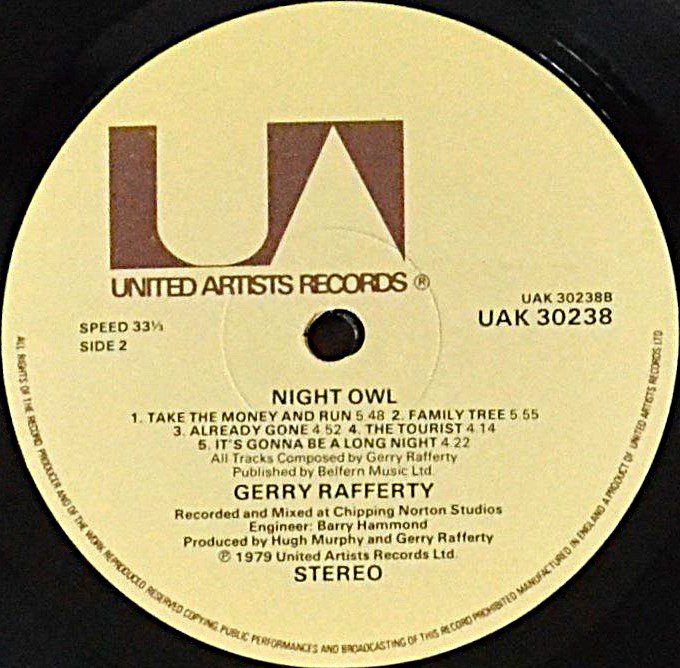
“Take the Money and Run” – Side B, Track 1
No relation to the Steve Miller song, but thematically they’d get along.
Musically:
Mid‑tempo rocker with a bit more edge. Tight, clean band performance; guitars are especially satisfying here.
Lyrically:
A clear swipe at the transactional side of the business—contracts, cash, and exit strategies. Hints at disappointment and betrayal, wrapped in a wry, singable package. It’s where the business of music really shows up in the lyrics, and it adds bite to the record’s second half.
“Family Tree” & “Already Gone” – Side B
These tracks bring things closer to home.
“Family Tree” touches on roots, heritage, and the way we carry our past with us.
“Already Gone” suggests emotional departure even when someone is technically still there.
Both deepen the album’s sense of a man looking around his life and taking stock—friends, family, fame, and the spaces in between.
“The Tourist” – Side B
One of the more quietly brilliant songs here.
Musically:
More reflective, almost cinematic in tone. Great late‑night listening; everything is just a bit softer at the edges.
Lyrically:
The idea of being a tourist in your own life—present but not quite connected. Fits perfectly with the recurring themes of alienation and dislocation.
“It’s Gonna Be a Long Night” – Side B, Closer
The album ends exactly where its title suggests: late, tired, but still going.
Musically:
A slow, weary sway. Feels like last orders at the bar—half the crowd gone, the band still playing.
Lyrically:
Resignation mixed with a flicker of hope. It doesn’t tie everything up in a neat bow, and that’s the point. As a side‑B closer, it’s excellent: the needle lifts, but the mood lingers.
Conclusion
“Night Owl” is Gerry Rafferty after the party, sitting at the kitchen table with a cup (or glass) of something, telling you what really happened.
For listeners and collectors, it offers:
Top‑tier songwriting that rivals “City to City,” with even more emotional depth. Lush, analogue late‑70s production that sounds superb on vinyl—wide stereo field, warm mids, and satisfying dynamics. A cohesive mood: nocturnal, introspective, and quietly powerful. While it didn’t generate a single as omnipresent as “Baker Street,” “Night Owl” has aged incredibly well. Many fans now see it as Rafferty’s most complete statement—less about chasing hits, more about telling the truth.
If you like:
Thoughtful lyrics, smooth, melodic soft rock, albums that reward listening all the way through… then the 1979 United Artists pressing (UAK 30238) is absolutely worth a place in your crate.
Other Recommendations
If “Night Owl” hits the spot, here’s where to go next.
More Gerry Rafferty on vinyl
The obvious companion piece. Features “Baker Street,” “Right Down the Line,” and “The Ark.” Slightly brighter in mood, but sonically and thematically connected.
Continues the refined soft‑rock vibe. A bit more varied in tone, with some overlooked deep cuts and strong melodies.
“Can I Have My Money Back?” (1971)
Earlier, more folk‑influenced Rafferty. A great way to hear where his songwriting started before the big‑budget productions.
Stealers Wheel – “Stealers Wheel” (1972)
The band that set him up for solo fame. Includes “Stuck in the Middle With You” and gives you a more band‑oriented, early‑70s spin on his style.
Similar artists & records
If you’re here for the smooth, literate, late‑70s sound:
Al Stewart – “Year of the Cat” (1976)
Story‑driven, sophisticated soft rock with lush arrangements.
Boz Scaggs – “Silk Degrees” (1976)
Slick, soulful soft rock with immaculate studio polish.
The Alan Parsons Project – “I Robot” (1977)
More conceptual and proggy, but shares that big, layered late‑70s production aesthetic.
Fleetwood Mac – “Rumours” (1977)
Emotional turmoil wrapped in pristine soft rock; if you like the craft and confession balance, this is essential.
Chris Rea – “Whatever Happened to Benny Santini?” (1978)
Bluesy, melodic rock with a similarly warm, radio‑friendly sound.
Pair “Night Owl” with any of these on a quiet evening, dim the lights, and you’ve got yourself a perfectly curated analogue night in.