Dimensions 26.5×19.5 cm.
“Tout Bleu, Tout Bleu”: The Poster That Bottled a Mood
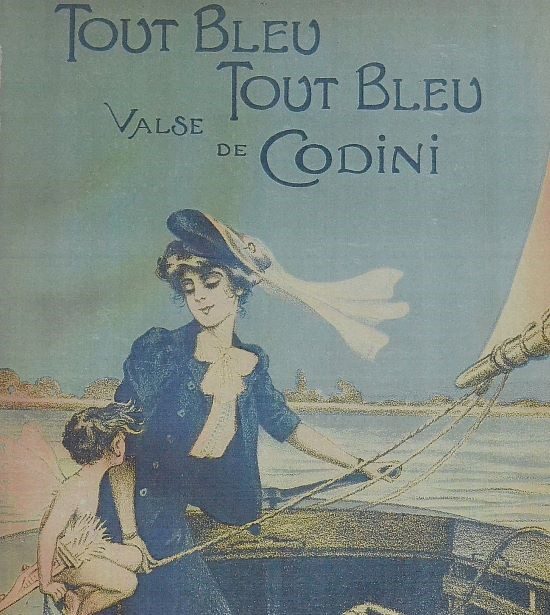
If you’ve ever wanted to step inside a color, this 1912 French poster gets you close. Titled “Tout Bleu, Tout Bleu” (literally, “All Blue, All Blue”), it advertises a waltz by Codini—but it sells much more than sheet music. It sells a feeling: sea air, soft elegance, and that quietly thrilling sense that life could be lighter.
Key takeaway: This poster is a masterclass in how early 20th-century advertising utilized art, typography, and emotion to make music feel like an experience you could own.
What You’re Looking At (In One Glance)
The image shows a stylish woman and a child seated in a small boat, surrounded by water and sky. Everything leans into blue—not just the pigment, but the promise of calm. At the top, the title repeats like a refrain: “Tout Bleu Tout Bleu”.
Down below, the print credits place it in Paris, with the publisher Cury‑Morot on Rue Montmartre, and a clear date: 1912—right in the glow of the Belle Époque, when posters were among the loudest voices in the city.
Why This Poster Works (Even If You Don’t Read Music)
Posters like this weren’t “decoration.” They were mass media—the Instagram ads of their day—designed to stop pedestrians in their tracks.
Here’s why this one still holds attention:
Color as persuasion: Blue is culturally tied to trust, depth, and distance (think: horizon lines, uniforms, sacred paintings). Here, blue becomes a brand identity.
A story, not a product shot: Instead of showing instruments or notes, it shows a scene—a visual daydream that suggests what the waltz might feel like.
Typography that sings: The lettering is airy and rhythmic, with a graceful curve that echoes the circular motion of dance.
A Bit of Cultural Context (The Fun Part)
1) Paris was the capital of the poster. By 1912, Paris had turned street advertising into an art form. Thanks to color lithography, printers could produce vibrant images at scale, and artists embraced posters as a legitimate canvas.
2) The waltz was more than a dance. The waltz had already conquered Europe in the 19th century, moving from scandalous “too-close” ballroom novelty to mainstream elegance. By the early 1900s, a waltz title didn’t just promise music—it promised romance, manners, and modern leisure.
3) Montmartre wasn’t just a neighborhood. The address “Rue Montmartre” hints at a wider cultural ecosystem: cafés, cabarets, publishers, illustrators, and composers feeding a hungry urban audience that wanted the new.
How to Read the Poster Like a Collector
Use this quick checklist:
Date & imprint: “1912” and “Cury‑Morot, Paris” anchor authenticity and provenance.
Condition cues: Fading and paper wear can signal age (and affect value).
Design language: The soft lines and elegant figures nod to late Art Nouveau sensibilities—less floral explosion, more refined mood.
The Quiet Genius of “All Blue”
“Tout Bleu, Tout Bleu” doesn’t shout. It drifts. And that’s why it’s powerful: it proves that great design can be both commercial and poetic—selling a waltz by selling a world.
Quick FAQ
Is this a music poster or an art poster? Both. It advertises sheet music, but it’s designed as a standalone visual art.
Why repeat the title twice? Repetition works like a chorus: memorable, musical, and hypnotic—perfect for a waltz.
What makes 1912 significant? It’s just before World War I, near the end of the Belle Époque—when optimism still shaped everyday aesthetics.


Reviews
There are no reviews yet.
Only logged in customers who have purchased this product may leave a review.